
Get a Free Quote
Thank You!
We'll get back to you shortly. For immediate help, call (828) 492-3560.
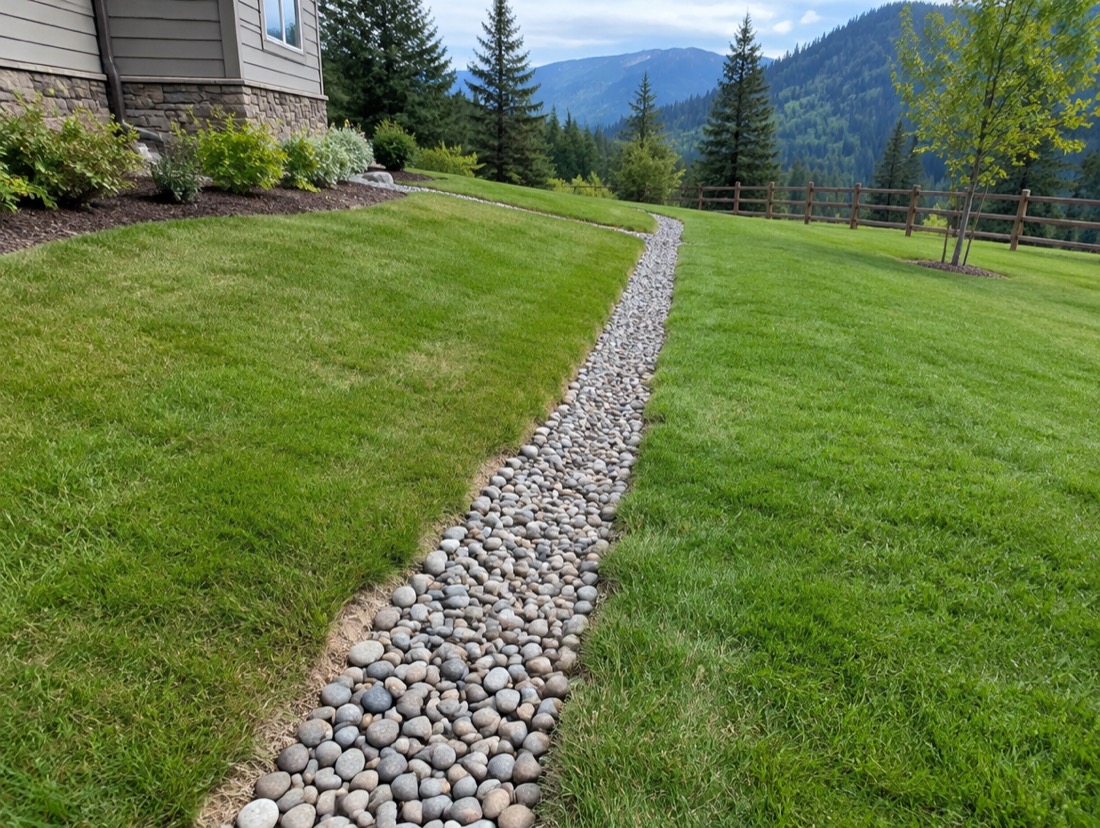
Asheville French Drain installs french drains and full drainage systems for homeowners across Asheville and the surrounding mountain towns. When water pools in the yard, runs downhill toward the house, or seeps into a basement or crawl space, we trace where it comes from and build a path to carry it away. What we install runs from french drain installation to catch basins, downspout drainage, trench drains, and dry wells. One crew solves the whole picture, not just one wet spot.
Up here the problem is rarely just the rain. The land is steep, so water gains speed coming downhill, often from a lot above yours, and the clay and rock underneath barely let it soak in. We set every drain at the right depth and slope and wrap the pipe in filter fabric so the clay cannot clog it. On sloped lots we add an interceptor drain across the uphill side to stop the water before it reaches the house. Every job starts with a free on-site drainage evaluation.
If any of these sound like your property, water is already working against your home. These are the signs we see most on Asheville's sloped lots.
After a storm, runoff sheets down the slope and collects against the house, the driveway, or a patio, sometimes straight from a neighbor's lot above you. On a grade, that water has to be intercepted and redirected before it piles up.
Many Asheville homes are built into the hillside, so water that should run past the house instead finds the foundation. A musty smell, damp walls, or standing water under the house means it is getting in and needs to be routed away.
Parts of the yard stay spongy long after the rain stops, and moss starts to take over. In the mountains that often means saturated clay, or an underground spring or seep feeding the spot from below.
Fast downhill water strips mulch and soil, carves channels across the yard, and builds pressure behind retaining walls until they bow or crack. Controlling where that water goes protects your landscaping and your walls.
Every system we install does one job: get water off your property and away from the house. Here is what we build across the Asheville area.
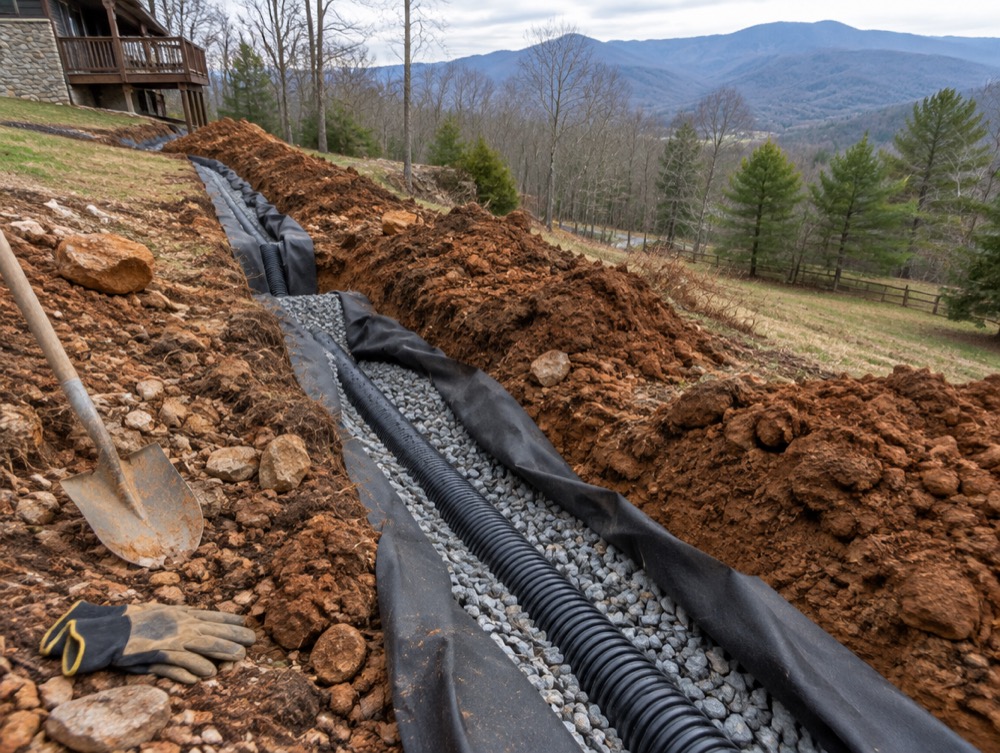
A french drain is the backbone of almost every fix we do in Asheville, and on a mountain lot it is usually the system that actually solves the problem. It is a gravel-filled trench with a perforated pipe set along the path the water already wants to take downhill. Groundwater and surface runoff drop into the pipe and get carried to a safe outlet instead of sitting in the yard or against the house.
On a slope the details matter even more than on flat ground. We dig to the right depth, hold a steady fall so gravity keeps the water moving, bed the pipe in washed #57 stone, and wrap the whole run in filter fabric so the clay and fine silt cannot clog it. Where water comes from uphill, we run the drain as an interceptor across the high side of the property to catch it before it reaches the house.
Then we plan where it ends. We can daylight the line lower on the slope, send it to a dry well, or tie it into a catch basin, but we settle the outlet first, because a drain with nowhere to go is just a buried puddle.
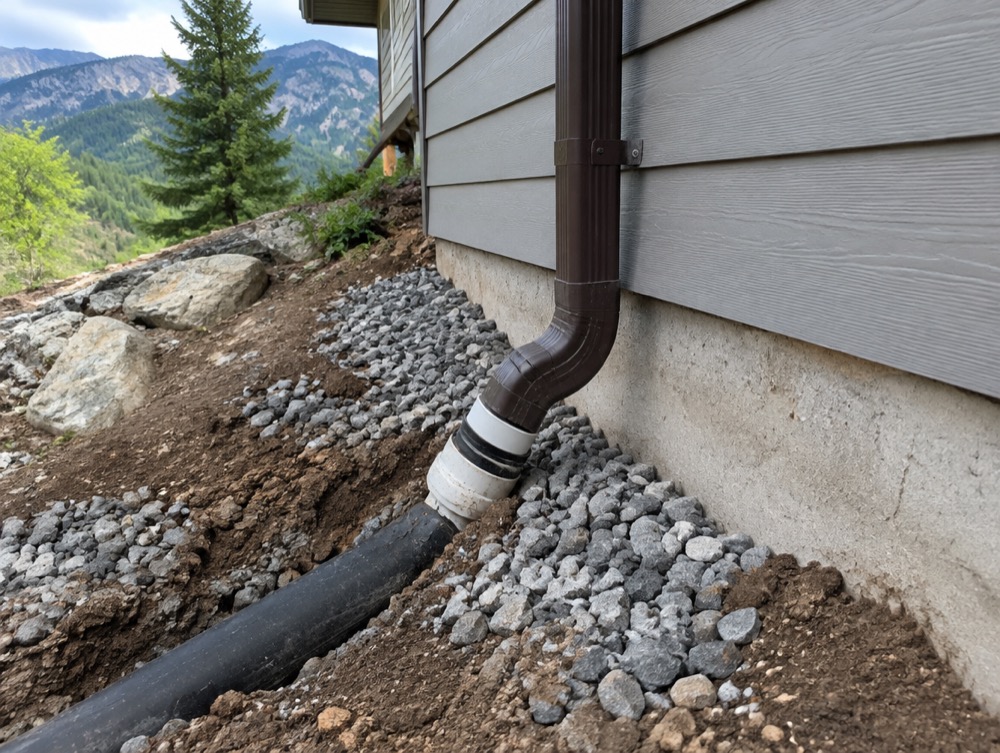
Your gutters pull a lot of water off the roof, and on most homes they dump all of it a foot from the foundation. On a hillside lot that water joins the runoff already coming downhill and ends up in the crawl space or against the footings.
We disconnect the downspouts and tie them into solid, buried pipe that carries the roof water well away from the house, out to a lower spot, a catch basin, or a dry well. Because the pipe is sealed instead of perforated, it moves that water fast and does not let it leak back out along the way. It is one of the cheapest, highest-impact fixes on a property, and we often pair it with a french drain so roof water and ground water are both handled at once.
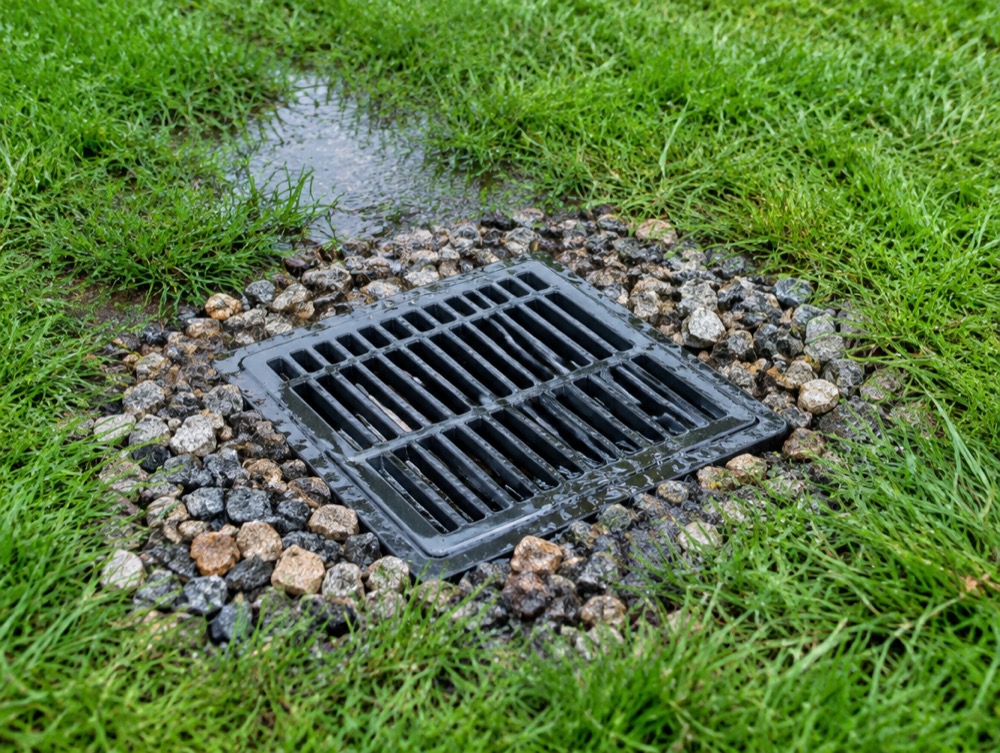
A catch basin is a grated box set into a low spot where water collects on the surface. Runoff pours through the grate, drops into the box, and feeds your buried drain line, so the puddle that used to sit there finally has somewhere to go.
On sloped Asheville lots they work best at the bottom of a grade, where a driveway meets the street, or anywhere water sheets across faster than the ground can absorb it. We size the basin and the outlet pipe to the water the spot actually sees and set it at the true low point. On bigger properties we tie several basins into one line and carry everything to a single safe outlet.
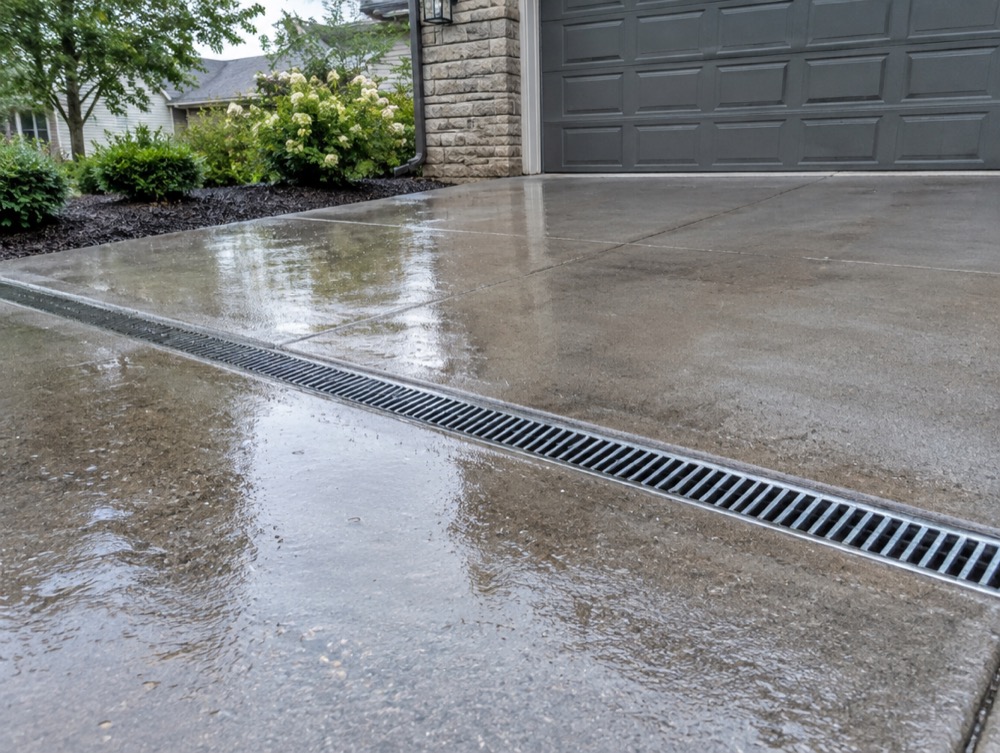
A trench drain, also called a channel drain, is a long narrow grate set flush into the surface to catch water as it sheets across pavement. You see them across driveways, garage aprons, and patios, which on a mountain lot often sit downhill of the house or the street.
They are the fix when water runs into the garage, pools at the bottom of a sloped driveway, or crosses a walkway every time it rains. We cut the channel into the concrete, set the grate flush so it does not catch tires or feet, and connect it to the line that carries the water underground. Unlike a single basin, a trench drain catches water along its whole length, so it is the right tool when runoff arrives as a wide sheet.
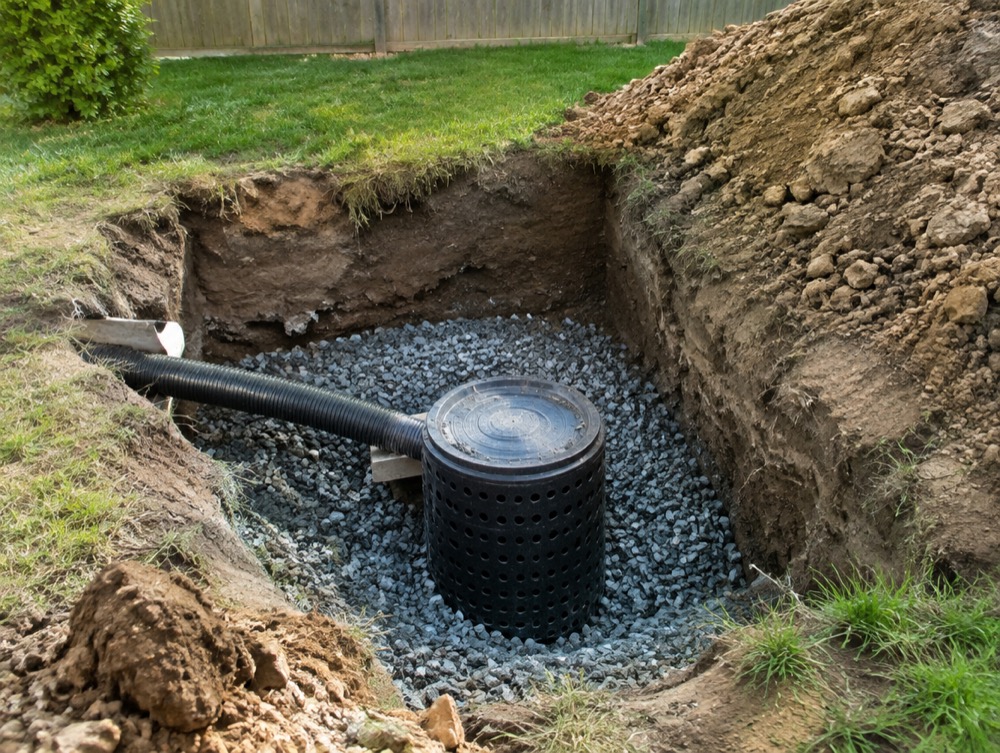
A dry well is a buried basin, filled with stone or built as a chamber, that takes a surge of water and holds it while it soaks back into the ground. It is the outlet we reach for when a lot has no lower point to daylight a drain and no street or ditch it can legally tie into.
A french drain, a downspout line, or a catch basin feeds the dry well, which buffers a heavy mountain storm and lets the water out slowly instead of dumping it on the neighbor below you. We size it to your roof area and how fast the soil drains, which matters here because our clay and rock take on water slowly. Placed right, it lets a full system work even on a tight, enclosed lot.
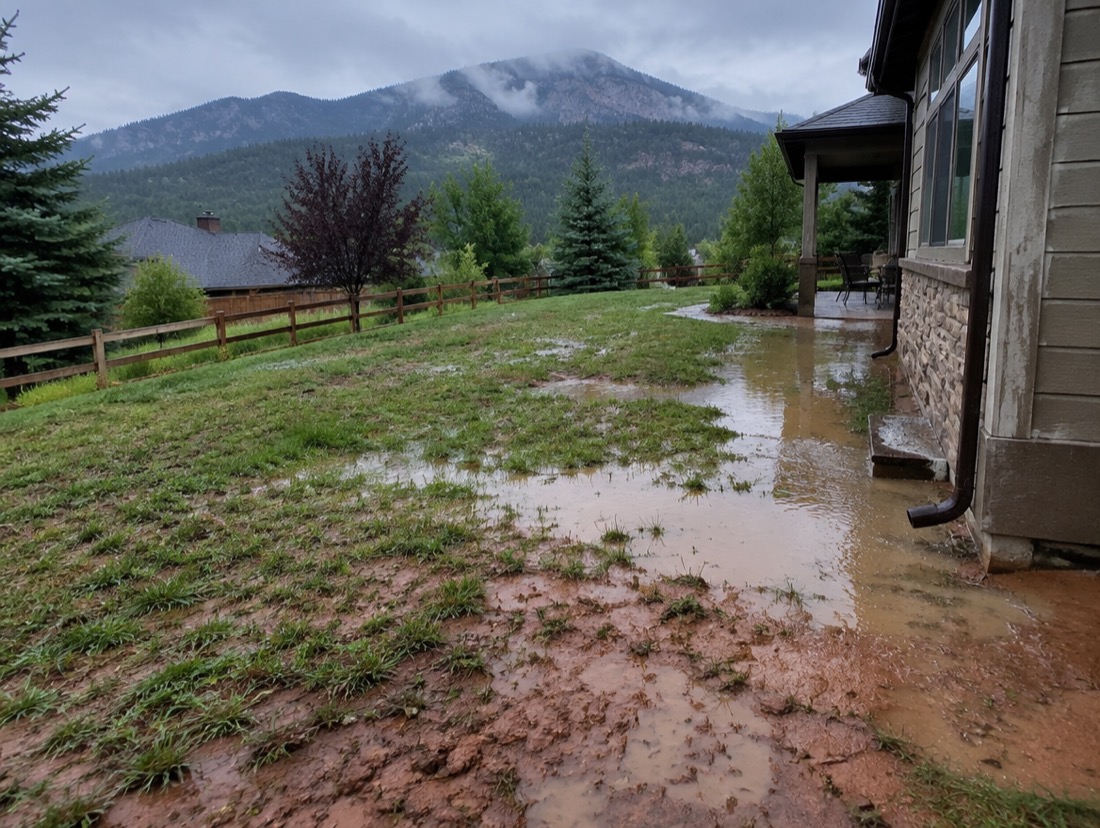
Standing water in the mountains is rarely about the rain alone. It is about the shape of the land and what is under it, and around Asheville both work against you. Between steep slopes, heavy rainfall, and ground that barely drains, water that should move on through instead piles up where you do not want it. Here is what is actually happening on your lot.
Almost every lot around Asheville sits on a grade. When it rains, water does not just fall on your yard, it runs onto it from everywhere uphill, picking up speed and volume as it comes. By the time it reaches a house partway down the slope, it can arrive as a fast sheet that overwhelms the yard and heads straight for the low side of the foundation.
Asheville gets well over 45 inches of rain a year, and the mountains just south and west are some of the wettest places in the eastern US. A single storm, or the remains of a tropical system, can drop several inches in a few hours. Ground that is already steep and slow to absorb cannot keep up, so most of that water becomes runoff.
Under most Asheville yards is a mix of heavy clay, weathered rock, and often only a thin layer of topsoil over the two. None of it lets water soak in quickly. Instead of percolating down, rain sits on the surface or slides across it, which is why a yard here can stay soggy for days after the sky clears.
To put a house on a slope, builders cut into the hillside and backfill around the foundation, which leaves the low side sitting right in the path of the water coming down. That is why so many Asheville homes deal with wet basements and crawl spaces. Add an underground spring or seep, common in the mountains, and a foundation can stay wet even between storms.
None of this changes on its own, because the slope and the soil are not going anywhere. The fix is to take control of the water: catch it before it reaches the house, and give it a built path to somewhere safe downhill. That is exactly what a french drain, and on a grade an interceptor drain, is built to do.
On a mountain lot, digging the trench is the easy part. Reading the slope and planning where the water goes is what makes a drain actually work. Here is how we do it.
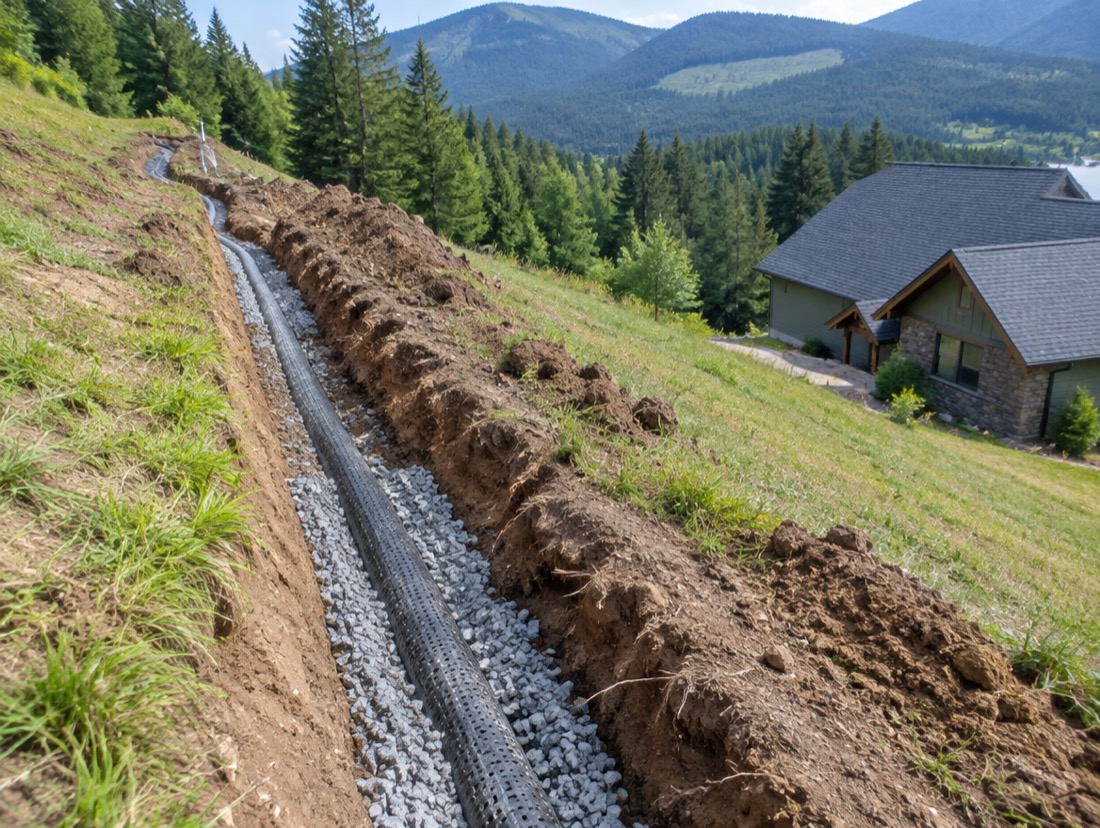
It starts with a free on-site visit, not a number over the phone. We walk the property, read the slope, and figure out where water enters, where it pools, and where it needs to end up, including any coming down from a lot above you. On a grade, finding the real source is most of the job.
Before we dig, we map the full path: where the drain runs, how deep, what fall it needs, and where it can legally let out. In North Carolina we cannot send water onto a neighbor or into the street, which matters even more downhill, so we lock in the outlet first, whether that is a daylight point lower on the slope, a dry well, or a catch basin.
We trench to depth, set perforated pipe on a bed of washed #57 stone at a steady slope, and wrap it in filter fabric so Asheville's clay cannot clog it. On a hillside we run an interceptor across the uphill side to catch water before it reaches the house. The trenching is the commodity part; the depth, the slope, and the fabric are what separate a drain that lasts from one that silts up in a season.
We run water through the system to confirm it carries off the way it should, then backfill and put the yard back together with soil, sod, or gravel over the line. On a slope we reset the grade and the plantings so the hillside holds, and you are left with a dry yard and a drain working out of sight.
We are not a landscaper or a general contractor adding a drain on the side. Fixing water on Asheville's slopes is the whole business, so you get a crew that reads grades and installs french drains every day, not someone figuring it out in your yard.
We come out, read the slope, and tell you what is really going on, even when the honest answer is a smaller fix than you expected. If a downspout line or a regrade solves it for less than a full french drain, we will say so, and if the water is a foundation problem, we will tell you that too.
You get a single fixed price in writing before we break ground. No hourly meter, no change order halfway through, and no bigger number waiting at the end. The quote is the price.
Every job is handled by licensed, insured crews and stands behind a written warranty. Your property is covered while we work and the drain is covered after we leave, so a fix that is supposed to last actually does.
Most drainage companies around Asheville will not put a number on their site. We will. A yard french drain here generally runs about $25 to $40 per linear foot installed, more for deep basement or foundation work, but the honest answer is that price depends on your slope and soil, so the ranges below are for budgeting and the exact number comes from a free on-site visit.
A downspout line or a short drain for one wet spot.
A standard run, often with a catch basin, to dry out a soggy or sloped yard.
Multiple drains, an interceptor, and a basement or foundation drain across the property.
What moves the price: how many linear feet you need and how deep the trench goes, how steep and hard to reach the lot is, our clay and rock (slower, harder digging than sandy soil), whether a basement or foundation is involved, add-ons like a dry well or interceptor drain, and putting the landscaping back afterward.
These are typical Asheville ranges for planning, not a quote. Every slope drains differently, so we price yours at a free on-site drainage evaluation before any work begins.
Straight answers to what we hear most during free drainage evaluations around Asheville.
Most french drain projects in Asheville run between about $1,500 for a short, single-area fix and $12,000 or more for a full hillside or basement system, with a typical yard drain landing around $2,500 to $6,000. Figure roughly $25 to $40 per linear foot for a yard drain, more for deep basement or foundation work. The real number depends on your slope, how far the run goes, and your soil, so every job gets a free on-site price first.
For most Asheville yards the trench runs about 18 to 24 inches deep, deeper for a basement or foundation drain. Depth matters, but slope matters more: the pipe needs a steady fall so gravity keeps the water moving to the outlet. On a graded lot we use that natural slope to our advantage, which is one reason mountain drains can work so well when they are planned right.
Yes, and a slope usually makes them work better, not worse, because gravity does the job of moving the water. The key on a grade is catching the water high, often with an interceptor drain across the uphill side, and giving it a clear path down to a safe outlet. A drain planned for the slope will outperform one dropped in without reading the grade.
Often, yes. Water in an Asheville basement or crawl space usually starts as surface and ground water moving downhill into the foundation. An exterior french drain, sometimes paired with a footing or curtain drain, intercepts that water before it reaches the wall and carries it away. If water is already inside, we will look at whether an interior drain or sump needs to go with it and tell you straight what it will take.
You intercept it before it arrives. On a sloped lot we install a french drain or a curtain drain across the high side of the property, so the water coming down from above drops into the pipe and gets routed around the house instead of into it. Grading and a catch basin often work alongside it to steer surface water the same way.
A poorly built one can fill with dirt and stop draining, and around here the culprit is our fine clay and silt washing into the pipe. We prevent it by wrapping the perforated pipe and #57 stone in filter fabric, which lets water through but keeps soil out. That fabric is the single biggest reason a drain keeps draining for fifteen years rather than silting up within a couple of seasons.
Sometimes a smaller fix is enough, and we will tell you if it is. Re-grading a low spot, extending the downspouts, adding a dry well, or cutting a swale can solve a mild problem on its own. When water is coming off a slope in volume or reaching the foundation, though, a french drain is usually the piece that actually holds up.
A properly built french drain in Asheville should last fifteen years or more, often much longer. It comes down to the filter fabric and the slope: keep clay and silt out of the pipe and keep the water moving, and there is little to wear out. The drains that fail early are almost always the ones put in without fabric or without enough fall.
It has to end somewhere safe, and in North Carolina you cannot legally send it onto a neighbor's property or into the street. On a slope that is usually an advantage, because we can often daylight the line at a lower point on the lot. Where there is no low outlet, we run it into a dry well that lets the water soak back into the ground, and we settle that outlet before we dig.
We install french drains and drainage systems for homeowners across Asheville and the surrounding mountain towns, from the slopes in town out to the coves and ridges around the metro.